Bulbs or Tubers? How to Tell What a Plant Stores
Bulbs or tubers can look alike in a packet, but their structure explains planting labels, shoots and dormancy so you can choose a sensible planting approach.
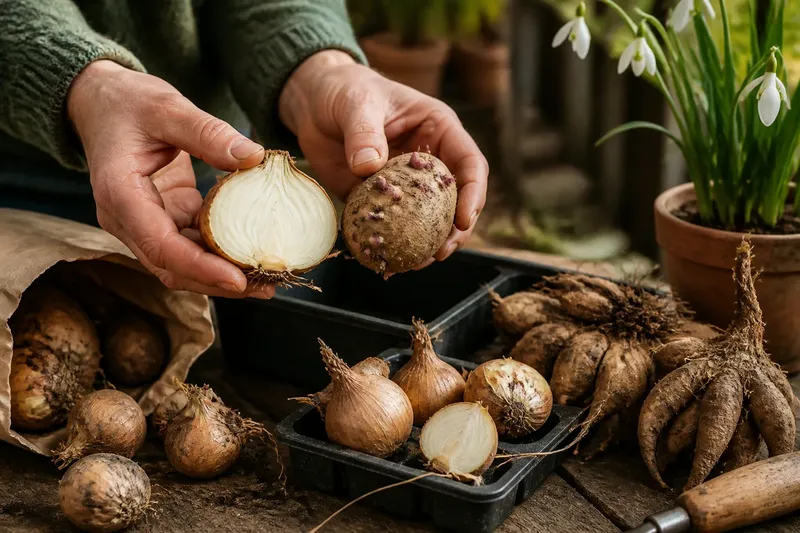
You tip a paper packet over a potting tray and out roll several brown, knobbly pieces. One has a papery skin; another looks like a small potato. If the label calls both of them bulbs, the word may be doing more work than the plant’s structure. Learning to tell bulbs or tubers apart helps make sense of planting instructions and the way each plant begins to grow.
The useful distinction is not simply shape or size. A true bulb is built around a short stem with fleshy leaf bases packed into a storage unit. A tuber is a swollen storage organ, often a stem, that holds food in its own tissue. Both help a plant survive an unfavourable season, but they organise that reserve differently.
Look for the layers
Cut a spare bulb lengthwise and you can usually see its parts clearly. The fleshy scales are modified leaves, gathered tightly around a central growing point. A dry, papery tunic may wrap the outside, as it does on many onions and daffodils. Other bulbs, such as lilies, have exposed overlapping scales instead of a complete papery coat.
At the base sits a compact stem plate. Roots emerge from it, while the shoot develops from the centre above. The bulb is therefore a complete storage package: leaf tissue, a short stem and a bud arranged together. Think of it as a folded set of leaves surrounding a small central button, rather than a single swollen lump.
That arrangement explains why a bulb can look quiet yet already contain the beginnings of its next season’s growth. The scales store food, and the central bud is positioned to send up a shoot. A firm bulb with intact scales and a sound base is generally a better prospect than one that feels soft or has damaged tissue.
Check for eyes
A tuber usually lacks the bulb’s neat stack of fleshy scales. A stem tuber, such as a potato, is a thickened portion of stem. Small buds, commonly called eyes, sit on its surface. Each viable eye can produce a shoot, and the tuber’s stored food supports that early growth.
Garden plants sold as tubers include dahlias and some begonias, though their storage organs can differ in form. A dahlia tuber is a thickened root attached to a crown, and the growing buds are on that crown rather than dotted across every swollen root. This matters: an isolated, plump root without a piece of the crown may not have a shoot bud from which to grow.
Plant labels often use everyday names loosely. “Tuber” may describe a storage organ in a broad gardening sense, while botanical descriptions distinguish stem tubers from swollen roots and other underground structures. For planting, note where the buds or crown are and follow the label’s orientation advice. If the organ’s identity is unclear, check the supplier’s description rather than guessing from its outline.
Why planting goes wrong
A common frustration is a healthy-looking organ that never sends up a shoot. With a bulb, the central bud may have been damaged, or the base may have rotted. With a dahlia, the crown may be missing or too damaged to carry a viable bud. A tuber’s swollen appearance alone does not prove that it has a growing point.
Before planting, inspect the storage organ gently. Look for firm tissue, an intact base or crown, and visible buds where that plant forms them. Discarding every small blemish is unnecessary, but soft, wet, foul-smelling or extensively mouldy tissue is a warning that decay may be spreading. Keep a questionable piece separate from sound material rather than pressing it into a shared planting tray.
Another problem is planting the right organ the wrong way up. A bulb’s pointed shoot end usually faces upwards and its root-producing base downwards. Tubers can be less obvious: a potato eye points out from the surface, while dahlia buds appear at the crown. If orientation is uncertain, lay the organ as the supplier directs; do not force a guess based only on which end looks narrow.
Say you find a dahlia clump in a shed with several swollen roots and a small, firm crown. You can identify the crown as the place to look for buds, then plant the clump with that point positioned as the label advises. The expected sign of a sound planting is a shoot emerging from the crown; a bare root without one should not be treated as equivalent planting material.
Match the label
Planting depth and timing are not decided by the word “bulb” or “tuber” alone. Species, local climate, soil and the plant’s preferred season all matter. A spring-flowering bulb and a tender summer tuber may have opposite planting seasons, even though both spend part of the year dormant underground.
Read the label for the plant’s name, planting season, depth, spacing and preferred conditions. Check whether the instructions assume free-draining ground, a pot, or a sheltered site. A heavy clay bed can stay wet around dormant storage organs; a container can dry more quickly than the garden soil. These details shape the decision more reliably than a generic rule about all bulbs or all tubers.
Where the right approach depends on the cultivar, supplier’s directions or local conditions, use those instructions as the deciding source. Labels may also use common names rather than precise botanical terms, so the named plant is often more useful than the storage-organ label.
What should you check?
Does a bulb have a base?
Look for a flat or slightly flattened stem plate, often with old root traces, beneath the fleshy scales. If the base is missing or badly damaged, the bulb may struggle to establish even when its outer layers look sound.
Where are the tuber buds?
For a stem tuber, look for eyes on its surface; for a dahlia, inspect the crown where the swollen roots meet. Planting material needs a viable bud, not merely stored tissue.
Why is the organ soft?
Softness can indicate rot or physical damage, especially if the tissue is wet, discoloured or unpleasantly scented. Keep it apart from firm material and avoid planting it in a way that could spread decay through a tray or pot.
Can the label settle the depth?
Use the plant’s own label or supplier guidance for depth and season, because those needs vary between species. The terms bulb and tuber explain structure, not a universal planting measurement.
Read growth habits
Structure offers clues about how a plant renews itself. Many bulbs build a replacement bulb or small offsets beside the original, while tuber-forming plants may enlarge storage organs or produce a clump. The exact pattern depends on the plant, but the location of buds helps explain where new shoots can arise.
That knowledge can prevent an unhelpful division. A clump of daffodils may be separated into bulbs, each with its own base and growing point. A dahlia clump should be divided only where each section retains a piece of crown with a bud. Cutting swollen roots into pieces without that connection can leave storage tissue but no shoot.
It also helps when a plant label seems contradictory. A garden centre may group underground storage plants together for convenience, while a botanical description uses a narrower term. Rather than treating the label as a complete account, look at the organ’s features and the plant’s named growth habit.
Keep the distinction useful
Bulbs and tubers are both ways of carrying stored food through a dormant period, but their parts are arranged differently. Scales around a stem plate point to a true bulb; buds on a swollen organ or at a crown point towards a tuber or another storage form. Neither label, by itself, tells you every detail of planting.
When you next sort a packet, use a clean tray and take a moment to inspect the base, scales, eyes or crown. Then match those observations to the plant name and its instructions. The main phrase, bulbs or tubers, is a starting distinction: the buds and the label together tell you what to do next.