The Knot Garden and Its Patterned Past
The knot garden’s history comes into focus through its Tudor-era setting, interlaced lines and contrasts with parterres, making old garden plans easier to read.
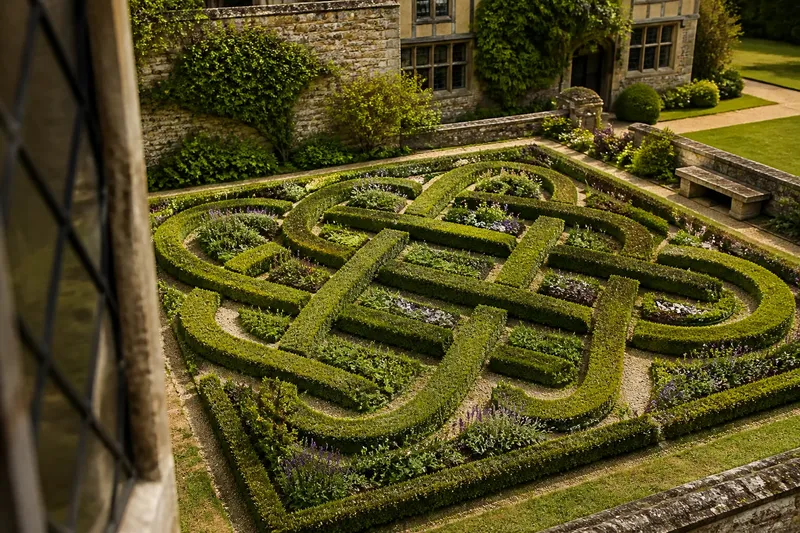
From an upstairs window, a clipped green line seems to slip beneath another and emerge on the far side. That woven illusion is the signature of a knot garden, a formal design associated especially with English gardens of the late Tudor period. Its patterned past becomes clearer when we place it among the garden forms and printed designs of that time.
Tudor garden setting
In the late sixteenth century, formal gardens around English houses were often laid out in ordered compartments, with paths, beds and clipped boundaries arranged to be viewed as part of the house and its grounds. Knot gardens belonged to this wider taste for patterned design. They were not a single, uniform tradition: surviving plans and descriptions show varied arrangements, and the label can cover designs that differ in how clearly their lines interlace.
Printed garden books helped circulate designs and ideas among readers and practitioners. Thomas Hill’s The Gardener’s Labyrinth, published in 1577, is one period source associated with knot patterns. Such books offer evidence that these designs were discussed and represented, but they do not establish that every garden copied a printed plan or used the same planting.
It is useful to distinguish the period’s knot work from the broader history of formal gardens. Symmetry and geometric beds existed in many forms; the defining visual trick of a knot is the apparent over-and-under passage of its bands. A garden with clipped shapes may be contemporary in spirit without being a true interlace.
Interlaced lines
A knot garden sets out bands that appear to weave across a bounded bed. The planted strips do not actually cross. Instead, their arrangement makes the eye follow one line above another, then pick it up again. Open ground or a contrasting surface between the bands helps the pattern remain legible.
This is different from a grid, which divides ground into separate compartments. It is also different from a parterre of mirrored scrolls or distinct beds. Those forms can share symmetry and clipped edges, but they ask the viewer to read separate shapes rather than a connected route.
The vantage point matters. From a window or raised terrace, the complete design can resolve into a single pattern. At path level, a visitor notices clipped edges, turns and changes of surface one at a time. Like following a strand through a woven basket, the eye needs enough contrast to distinguish one line from the next.
Books and evidence
Historical claims are strongest when they stay close to the evidence. A dated garden book can show that a design was published; a surviving plan can show an intended layout; a garden that has been restored may combine older evidence with later choices. Those sources answer different questions and should not be treated as interchangeable.
For example, a printed pattern does not prove that a particular household planted it exactly as drawn. Nor does a modern reconstruction automatically reproduce an original bed in every detail. When reading a garden’s past, look for the date and provenance of a plan, note whether the site’s layout has changed, and separate documented features from interpretation.
This caution also applies to symbolism. Interlaced lines can suggest connection or skill to a present-day viewer, but that response alone cannot establish what a maker intended. Begin with what can be seen or documented: the outline, repeated shapes, materials, paths and relation to the house.
Materials and meaning
Living lines give the knot a distinct character. Low evergreen edging creates a continuous outline against gravel, soil or grass. Herbs and other compact plants can bring varied texture and scent, though growth may soften the geometry. Materials are part of the design’s visual language, not merely what fills the bed.
A pale surface can make dark planting stand out. Grass gives the spaces between bands a softer, greener appearance; bare earth keeps the drawing spare. The right choice depends on the design and its setting. A busy background can compete with delicate lines, while a quieter one helps the weave read clearly.
Which form fits?
What distinguishes a knot from a parterre?
In a knot, the bands appear to pass over and under one another, creating a connected route for the eye. A parterre more often presents separate, balanced compartments or scrolls. Both can be formal, but their visual logic differs.
What can a period garden book tell you?
A dated book can show that a pattern or gardening idea was in circulation at the time of publication. It cannot, by itself, prove that a particular garden followed that design or that its planting matched the illustration.
Why does the viewing point matter?
The full interlace is easiest to recognise from above or from a slightly raised position. At ground level, paths and clipped edges reveal the detail, but parts of the pattern may disappear from view.
Can a modern knot garden reflect an old design?
It can draw on historical patterns, materials and principles, while still being a contemporary interpretation. To describe it accurately, distinguish the evidence behind its layout from the choices made during restoration or new construction.
Reading one garden
Say you are examining an invented garden beside an old house, and a surviving plan is dated to the late sixteenth century. First, compare the plan’s outline with the beds on the ground; suppose the central crossing lines match, but the present surface is gravel where the plan gives no material. Next, consult the site’s restoration notes; imagine they record the gravel as a later choice. The careful conclusion is that the interlaced layout has period evidence, while the gravel belongs to a later interpretation. If no dated plan or reliable site record exists, describe the visible pattern without assigning it a precise historical date.
When you look at a knot garden, begin with the whole outline and the best viewpoint. Trace a single band, notice where it seems to disappear and return, then examine the surface between the lines and the paths around them. These details help distinguish an interlaced design from a set of compartments, while historical records can show how much of the visible arrangement belongs to the past.
The knot garden’s history becomes easier to read when its geometry is considered alongside its evidence: a period book, a surviving plan, or a later restoration record. The main search phrase, knot garden history, is not a claim that every woven bed has the same origin. It points instead to a useful habit of looking: follow the lines, then ask what the documents can actually support.